In the week of October 12–18, a single question dominated the Persian press: what is happening to ships in the Strait of Hormuz? Each new "mine" statement from the IRGC was met by a different account from the United States, India, Singapore or international maritime bodies. At the same time, Tehran and Washington kept exchanging messages through mediators, sanctions lists grew longer, and attacks from Yemen on Saudi Arabia targeted aviation and energy facilities. This piece is compiled from the reports Farsçadan published during the week. Each piece of information is attributed to the relevant report and to the outlet that report relied on.
The week's three threads
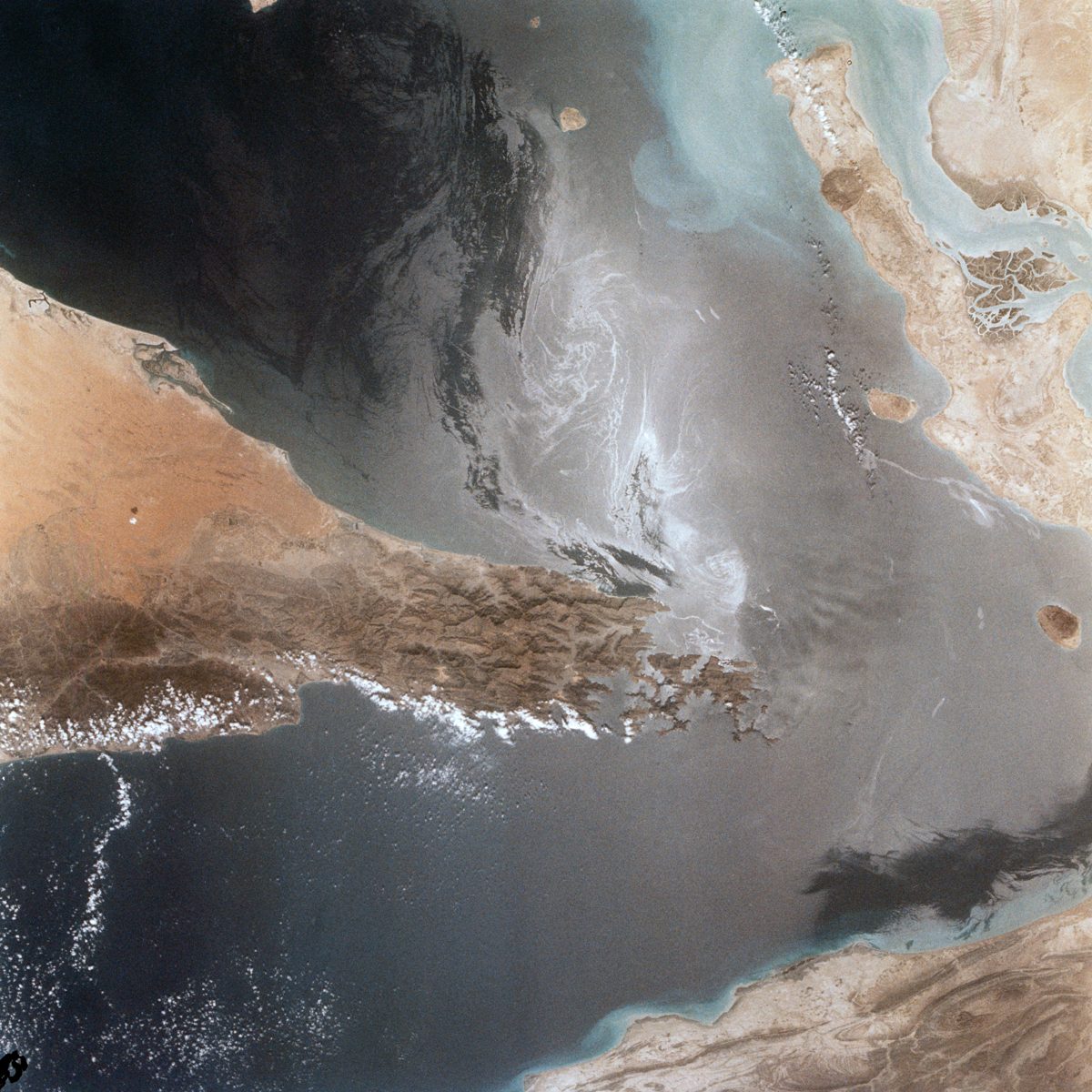
1. Hormuz: mine or attack?
The week opened with an IRGC statement carried by Ettelaat: a third supertanker since Saturday had hit a mine and caught fire while trying to pass through a "prohibited" route with its navigation systems switched off. IRGC Navy commander Ali Ozmayi said ships that turn off their identification systems would be treated as "enemies" (third supertanker in Hormuz). On Wednesday, Hamshahri, citing the IRGC, reported that a ship carrying more than 2,500 containers had struck a mine and sunk. Iran International, citing the Maritime and Port Authority of Singapore, reported that a ship named JFS Pride had sunk after being "attacked," and that the source of the projectiles was "unclear" (container ship sinks).
The same pattern repeated on the evening of October 16. According to IRNA, the IRGC said a supertanker carrying more than 2 million barrels of oil had hit a mine. India's shipping minister, however, said a tanker with 15 Indian sailors aboard had been hit "by a projectile" in the strait (IRGC says "mine," India says "projectile"). By the weekend, the count itself was in dispute. IRNA, citing TASS, reported that 22 ships had been attacked in the first 13 days of October. The UK Maritime Trade Operations center (UKMTO) recorded 12 attacks in the week of October 10–16 and said its data may be incomplete (attack tally diverges).
The blockade's impact was also described in conflicting terms. According to Iran International, CENTCOM commander Brad Cooper said the blockade was "impenetrable" and had stopped at least $25 billion in crude exports. The same day, a Reuters report also carried by Iran International said at least eight LPG-laden ships had left the Gulf of Oman since mid-July (CENTCOM and Reuters).
2. The diplomatic channel stays open as pressure mounts
According to Hamshahri, Supreme National Security Council Secretary Mohsen Rezaei said the United States had accepted some of Iran's seven conditions but that Tehran found the response "insufficient" (seven conditions). The next day, Ettelaat reported Deputy Foreign Minister Kazem Gharibabadi as saying Tehran was "finalizing" its response to the U.S. ceasefire proposal (Gharibabadi). At the end of the week, according to Donya-ye Eghtesad, Qatar's foreign ministry spokesman said roughly $6 billion in Iranian funds held in Qatar served as a "confidence-building" tool in the talks. The spokesman said Iran's proposal on Hormuz security had stalled because of Washington's insistence on also putting the nuclear file on the table (Qatar and the frozen funds).
The nuclear issue stayed on the agenda all week, voiced by different figures. According to Khabaronline, former Foreign Minister Zarif said Iran does not have enough enriched uranium to build a bomb (Zarif). Hamshahri reported that an unnamed senior diplomat said withdrawing from the NPT was being considered as a "serious option" (NPT). According to Hamshahri, President Trump said he would not use nuclear weapons but did not rule out the MOAB bomb (Trump and the MOAB).
On the pressure front, Ettelaat reported on a joint statement by 29 countries, led by Britain, blaming Iran for the Fairford incident, and on London's sanctions against two Iranians (Fairford statement). The U.S. Treasury added 16 people and a number of entities to its sanctions list (U.S. Treasury). According to a Hamshahri report citing Bloomberg, Lebanon's central bank also revoked the license of Iran's Bank Saderat (Lebanon).
3. The Yemen–Saudi front
According to Donya-ye Eghtesad, Houthi spokesman Yahya Saree said King Khalid Airport in Riyadh had been targeted with a ballistic missile. According to IRNA and ISNA, Emirates, Qatar Airways and Etihad then suspended or canceled flights to Saudi Arabia (Riyadh airport). According to IRNA, the Saudi Energy Ministry confirmed that Aramco's administration building in Dhahran had been hit (Dhahran). Ettelaat, citing The Wall Street Journal, reported that the number of aircraft at Riyadh's airport fell from 134 to 38. The Houthi claim to have downed a Saudi fighter jet was not confirmed (Jeddah and Riyadh).
Alongside these three threads, reports of repression also stood out on the domestic agenda. According to Iran International, Amnesty International said executions linked to the Dey uprising had reached at least 34 (Amnesty). Fourteen political prisoners in Evin Prison also warned that repression was intensifying (Evin). According to a roundup by Iran International, the Assembly of Experts called for "strict enforcement" of the hijab law (Assembly of Experts).
Framing differences
Throughout the week, the same facts became different headlines in different camps. The difference usually lay not in the numbers but in which information was put first.
| Source (orientation) | Event | Framing |
|---|---|---|
| Kayhan (Hardline, Supreme Leader's line) | Container ship sinks in Hormuz | Presented mines as a "tool to punish ships that break the rules" and as proof of Iran's sovereignty |
| Iran International (Opposition, diaspora) | Same event | Used the word "attack," citing Singapore and Reuters |
| Kayhan (Hardline) | IMF forecast of a 7.6% contraction | Highlighted the 2027 recovery and the drop in inflation |
| Iran International (Opposition, diaspora) | Same forecast | Highlighted the 2026 contraction and the Statistical Center of Iran's 10.1% decline figure |
| Kayhan (Hardline) | Fed rate hike | Presented it as the result of Iran's "war of attrition strategy" |
| Hamshahri (Tehran municipality, principlist) | Rezaei's seven-conditions statement | Led with the rejection under the headline "a shock to the White House's calculations" |
| Khabaronline (Moderate conservative, Larijani circle) | Same statement | Put the partial U.S. acceptance in the headline |
| Ettelaat (Established daily, moderate-traditionalist) | U.S. Treasury sanctions | Framed them as a pressure campaign following a "failed U.S. attack" |
| Donya-ye Eghtesad (Economic daily, technocratic) | Supertanker incident | Used OSINT data to point out that the ship's AIS signal had been off for weeks |
In the IMF case, both sources reported the same 7.6% figure (IMF forecast). In the Fed story, Kayhan quoted scholar John Mearsheimer's "attrition" assessment, while ISNA highlighted Nancy Pelosi's criticism and Khabaronline the war's cost to U.S. households (Fed). In foreign news, by contrast, different camps often republished the same wire copy. In the story on Macron's Gulf trip, IRNA, Khabaronline and Hamshahri all relied on the same Reuters text (Macron).
The Turkey angle
The week's story of most interest to Turkey was the headscarf ban in Azerbaijan's schools. According to IRNA, protests spread to the front of Azerbaijan's Consulate General in Istanbul, and Baku asked Turkey "not to interfere in its internal affairs." The number of detentions varied by source: Azerbaijan's Interior Ministry cited 37 people, while Kayhan claimed more than 100 and Hamshahri more than 200 (hijab ban). According to Kayhan, Foreign Minister Hakan Fidan and former Prime Minister Binali Yildirim later softened their tone. Kayhan presented this as Ankara "backing down" (Ankara's stance).
ISNA reported warnings from some Turkish political parties that the Mecca Pact between Turkey, Pakistan and Saudi Arabia could pull Turkey into the Yemen war. ISNA did not name the parties (Mecca Pact). According to Iran International, the governor of Lebanon's central bank listed Turkey among the regional countries restricting Iran's financial system (Lebanon). Turkey was not among the 29 countries that signed the Fairford statement (Fairford statement). ISNA and Khabaronline reported the flooding in Istanbul without adding any political framing (Istanbul floods).
What to watch next week
- October 19–21: According to the Élysée Palace, French President Macron will visit Kuwait, the United Arab Emirates, Bahrain and Qatar to discuss Hormuz and the energy crisis (Macron).
- October 19 (Monday): According to Kayhan, the registration and self-declaration deadline for the kalabarg increase was extended to this date (kalabarg).
- October 22 (30 Mehr): According to the schedule published by Ettelaat, Mehr cash aid will be paid to income deciles 4 through 9 (payment schedule).
- Items with no date announced: No date has yet been given for delivering Iran's response through mediators, as mentioned by Gharibabadi, or for the G7 energy meeting Macron said would be held "in the coming weeks."