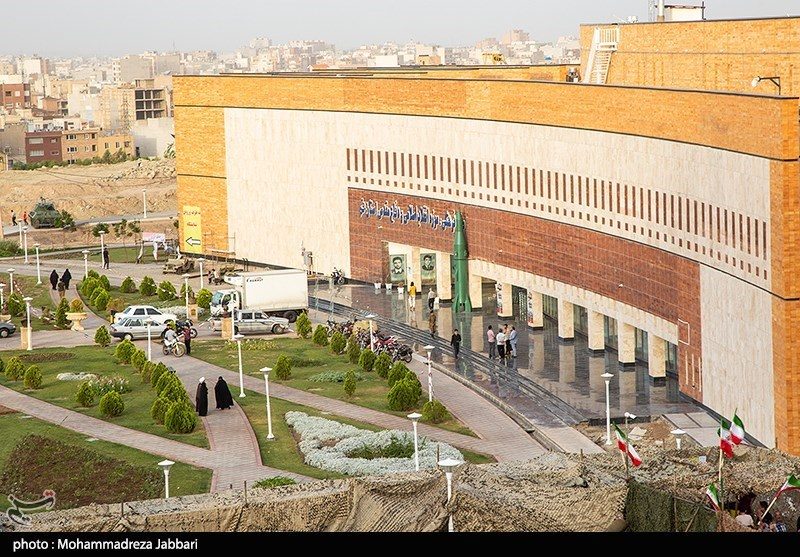
The IRGC's Aerospace Force unveiled a new "missile city" on Monday (Aban 9, last week); when footage from the ceremony was released on Tuesday (Aban 19), it generated wide coverage in Israeli media. According to Hamshahri, citing Vatan-e Emruz, the ceremony was attended by Joint Chiefs of Staff Commander Brigadier General Ali Abdollahi and IRGC Aerospace Force Commander Major General Seyed Majid Mousavi; the presentation included ballistic and cruise missiles from different generations, hints of underground launch infrastructure, and a "matte-finished" new weapon on display.
From the released footage, analysts identified the Kheibar Shekan, Emad, and Qadir ballistic missiles along with the Paveh land-attack cruise missile; these weapons had been used during the 40-day war in June–July 2026 against U.S. and Israeli military assets in the region. According to Hamshahri's technical assessment, alongside the Paveh cruise missiles, a "matte" weapon whose features could not be clearly seen may be a cruise missile with enhanced stealth properties. In addition, the long cylindrical vertical-launch missiles visible in the background, with their warhead profiles, were assessed as possibly being the second-stage booster of a system with a range exceeding 2,000 kilometers; some details in the scene suggest underground silos or rail-based launch systems.
According to Hamshahri's reported technical assessment, the significance of underground launch infrastructure lies in its capacity to enable successive and rapid missile launches; such a system could complicate an adversary's calculations about striking Iran's missile stockpiles first. Israeli missile expert Tal Inbar, based on the footage, claimed that Tehran had this time mounted the warhead of its hypersonic Fathah-1 missile onto a Kheibar Shekan airframe; according to Inbar, this combination would provide advanced maneuvering capability to evade radar and air-defense systems.
Parliament Speaker Mohammad Baqer Qalibaf, in a written statement after the unveiling, described the missile city as "a clear message to the enemies": "This time the geography of war will be determined by Iran's armed forces," he said, and emphasized that the project was completed "under sanctions, military and security threats, and the fire of war." Joint Chiefs of Staff Commander Abdollahi also responded on stage to Netanyahu's recent remark that "either we destroy Iran or Iran destroys us," saying, "This is not a new word; we will certainly destroy them." He claimed that despite the U.S. using "an unprecedented quantity of ammunition" in the previous war, it failed to achieve its objectives. IRGC Aerospace Force Commander Mousavi said "if necessary, we will bring all of the enemy's assets in and outside the region under fire."
How the Persian press covered it
| Source (orientation) | Headline / framing |
|---|---|
| Hamshahri (semi-official) | "What the footage revealed": used technical and analytical language focused on new weapon clues, range estimates, and Israeli expert reaction; framed the unveiling as a military-technical development. |
| Kayhan (hardline, Supreme Leader's line) | "The missile city is our clear message to the enemies": elevated Qalibaf and Abdollahi's "we will destroy them" words to the headline, presenting the ceremony in triumph and defiance language. |
Context
Background:
- June–July 2026: The U.S. and Israel waged a 40-day war against Iran; the Kheibar Shekan, Emad, Qadir, and Paveh missiles were employed in this conflict.
- Aban 9, 1405 (approximately October 31, 2026): The IRGC Aerospace Force unveiled the new missile city.
- Aban 19, 1405 (November 10, 2026): Footage from the unveiling was released and drew wide coverage in Israeli media.
Key figures / concepts: Kheibar Shekan (literally "Kheibar breaker" in Persian) is part of Iran's solid-fuel, medium-range ballistic missile family and is known for rapid-launch capability. Emad and Qadir are liquid-fueled ballistic missiles and have been part of the IRGC Aerospace Force's strategic capacity for years. The Paveh cruise missile is also known for its "ground-attack" capability against land targets.
By the numbers:
- According to experts, the vertical-launch missiles visible in the background can exceed a 2,000-kilometer range (technical assessment cited by Hamshahri, November 10, 2026).
- The displayed weapons include the Kheibar Shekan, Emad, and Qadir ballistic missiles, representing at least three different ballistic missile families used in the 40-day war of June–July 2026 (Hamshahri, November 10, 2026).
- The two commanders attending, Abdollahi and Mousavi, were active figures in the command structure during the previous war (Hamshahri, November 10, 2026).
What's next: No official response to the missile city from Israel and the U.S. has been announced; while Israeli experts like Tal Inbar continue technical assessments, no official confirmation has emerged about whether the "matte" weapon is a new cruise missile or what range it possesses. What Qalibaf's words—"we will determine the geography of war"—will mean in practice remains unspecified. The ceremony was also deliberately timed to coincide with the death anniversary of IRGC Aerospace Force former commander martyr Hassan Tahrani Moghadam and "Aviation Day" in Iran, a detail Kayhan's report also highlighted.