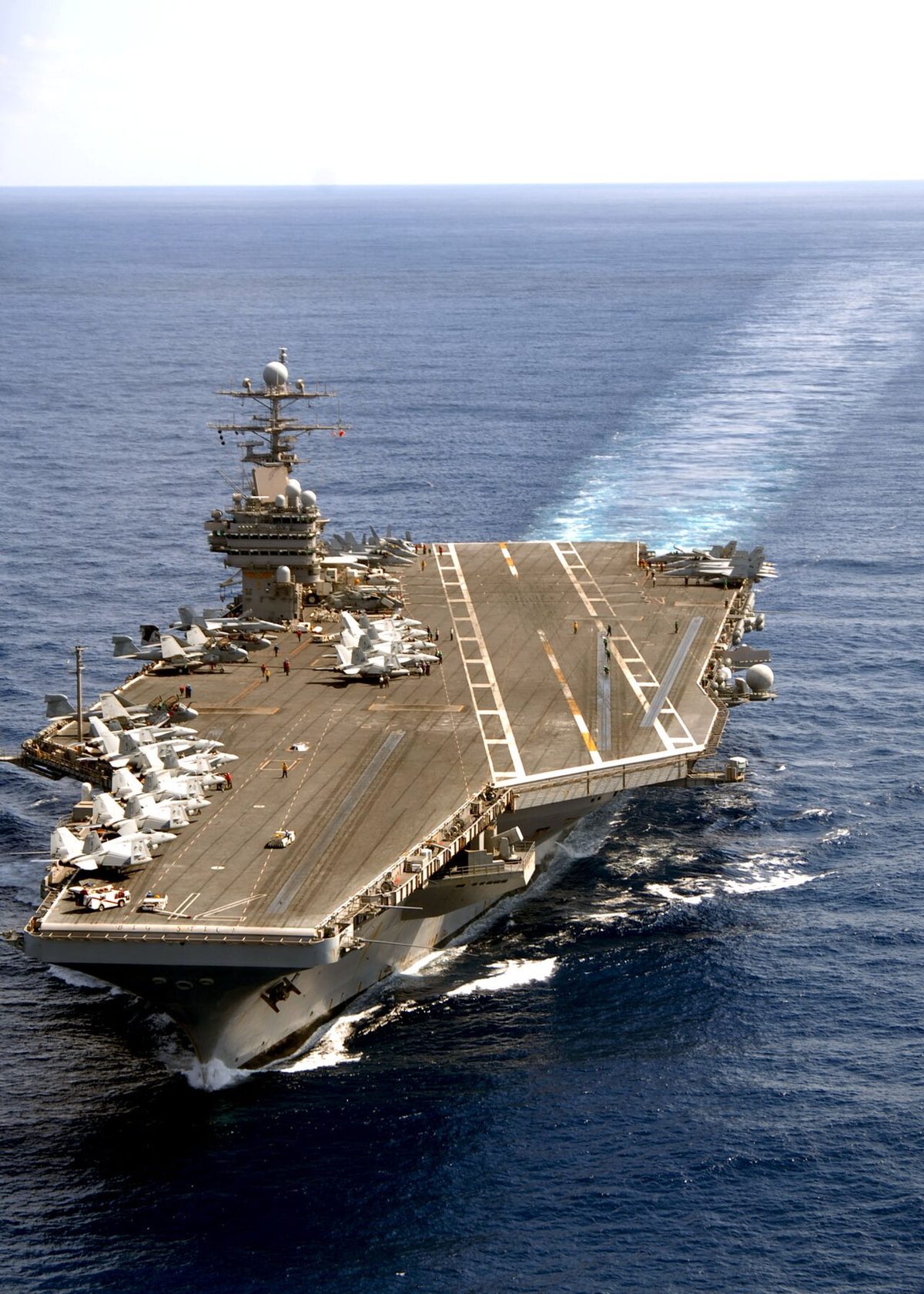
The US Navy's nuclear-powered aircraft carrier USS Theodore Roosevelt left San Diego on Sunday for the Middle East, where tensions with Iran persist. According to Ettelaat, citing US officials, the deployment could push the total potential US military presence in the region above 60,000, described as the largest buildup since the 2003 invasion of Iraq.
The Nimitz-class supercarrier, flagship of Carrier Strike Group 9, is accompanied by the guided-missile cruiser USS Chosin and destroyer squadrons. Its Carrier Air Wing 11 includes F-35C and F/A-18 Super Hornet fighter jets, electronic warfare aircraft and early-warning planes. A day later, an amphibious ready group led by the USS Makin Island also left San Diego; the group is carrying the 13th Marine Expeditionary Unit, made up of more than 2,000 Marines, aboard three ships including the USS John P. Murtha and the USS Anchorage.
The Associated Press, citing US officials, estimated that a total of 9,000 to 10,000 troops will be deployed and are expected to arrive in the region by the end of November; the United States currently has more than 50,000 troops there. A US official told Al Jazeera that three carrier strike groups and two amphibious ready groups could be deployed in the region by the end of November: "Military commanders and political leaders will have a lot of options for dealing with Iran."
The carriers USS George H.W. Bush and USS George Washington are currently continuing operations against Iran in the Arabian Sea, and the USS Boxer amphibious group is also on station. The US Navy has kept two carriers continuously deployed in the region since the US-Israeli war against Iran began in February. The Theodore Roosevelt is expected to replace the George Washington; depending on the rotation schedule, all three carriers could be on station at the same time for a period.
How the Persian press covered it
The established daily Ettelaat ran the story under the headline "the largest Middle East buildup in 23 years" and reported the development in plain language, largely as a military logistics story. The opposition, diaspora outlet Iran International presented the same deployment, citing the Associated Press, within a framing of "escalating tensions"; referring to an earlier attempted attack on a flydubai pilot and a suspicious incident in the UK, it included some expert assessments that Tehran could turn to "asymmetric warfare tactics." This assessment was presented as a possibility, not as confirmed information.
Context
The deployment comes as maritime traffic in the Strait of Hormuz is being affected by the US naval blockade (see Tanker attack in Hormuz). Washington says it has halted Iran's oil exports through this blockade, while Tehran is demanding that the blockade be lifted and economic pressure eased. In April, the US Navy deployed three carrier strike groups to the region simultaneously for the first time since 2003; the new deployment suggests this could happen again. The development coincided with the days when the Trump administration was discussing its next steps on Iran at Camp David (see Secret meeting at Camp David).