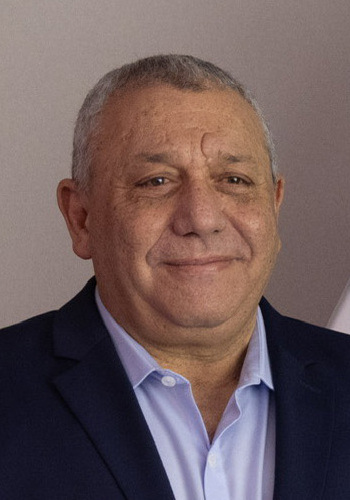
Gadi Eisenkot, leader of the Yesh Atid party and tasked by Israel's president with forming a government, said Benjamin Netanyahu should not remain in power "one more minute." According to Hamshahri's account, Eisenkot described Netanyahu as "a threat to Israeli democracy." According to Khabaronline's report from Anadolu Agency, the former chief of staff made these remarks on a Sunday evening during coalition negotiations, saying: "The attitude of Netanyahu and his inner circle constitutes a tangible, direct, and urgent threat to Israeli democracy. Under no circumstances should Netanyahu remain in power one more minute."
According to Khabaronline's account from Israel's Yedioth Ahronoth newspaper, Eisenkot also stated that "it is clear that no fair elections can be held as long as Netanyahu continues as prime minister, and this is the fundamental and central concern in coalition negotiations." These comments were in response to earlier statements from the interim prime minister; Eisenkot had previously suggested he could propose forming a national unity government to Netanyahu, but that he himself would need to head it.
According to English-language sources, Eisenkot pledged that he would not serve in a Netanyahu-led government, even under a rotation agreement (Times of Israel). President Isaac Herzog tasked the former military chief with forming a government after consulting with parties following elections; Eisenkot has 28 days to form a coalition, and if he fails, Herzog could offer the opportunity to Netanyahu (Al Jazeera, Nov. 8, 2026).
According to Khabaronline's report, Eisenkot's statement came at a time when coalition negotiations are stalled; internal divisions within the party continue over which alliances will form the government. According to an Al Jazeera report from Nov. 3, 2026, some opposition leaders openly voiced support for Eisenkot in an effort to remove Netanyahu from power; however, it remains unclear whether the fragmented opposition blocs can agree on a common coalition formula.
How the Persian press covered it
Three sources reported Eisenkot's remarks, but with different emphases:
| Source (orientation) | Headline / framing |
|---|---|
| Hamshahri (Tehran municipality, principlist) | "Netanyahu should not remain in power one more minute" — places the direct quote in the headline |
| IRNA (State news agency) | "Political disagreements in Israel escalating" — frames the crisis as Israeli internal instability |
| Khabaronline (Reformist) | "Eisenkot: Netanyahu's attitude is an urgent threat" — focuses on coalition negotiation details |
Context
Background:
- Oct. 27, 2026: General elections held in Israel; the result did not provide any single bloc with enough seats to form a government.
- Nov. 8, 2026: After consulting with parties, President Isaac Herzog tasked Eisenkot with forming a government; 67 Knesset members had recommended him (Farsçadan).
- Nov. 8, 2026: According to Al Jazeera's report, opposition leaders announced they were backing Eisenkot in an effort to remove Netanyahu.
Who is who / concept: Gadi Eisenkot, former chief of staff of the Israeli Defense Forces (2015–2019) and one of the leaders of the centrist Yesh Atid party (in English-language sources referred to as part of the "National Unity" bloc); his son and nephew lost their lives in fighting in Gaza. Yedioth Ahronoth is one of Israel's most widely read daily newspapers and is frequently cited for political insider reporting. Yesh Atid (meaning "There Is a Future" in Hebrew) is positioned as centrist in Israeli politics and frequently forms alliances with anti-Netanyahu blocs.
By the numbers:
- Eisenkot has a constitutional period of 28 days to form a government (Al Jazeera, Nov. 8, 2026).
- Elections were held on Oct. 27, 2026; the results gave no bloc an outright majority (Al Jazeera, Nov. 8, 2026).
- According to an Al Jazeera report from Nov. 3, 2026, numerous opposition party leaders announced their support for Eisenkot with the goal of removing Netanyahu.
What's next: Eisenkot's coalition negotiations are ongoing. If he fails to form a government within the deadline, President Herzog could transfer the task to another leader, possibly Netanyahu. According to the Israeli press, this process will directly affect the country's political stability after the Gaza war; if a coalition cannot be formed, new elections are also considered among possible options.
Fairness note: Eisenkot's assessment of Netanyahu was directly attributed to him; this report contains no editorial commentary or bias. Since the report conveys a political assessment rather than criminal charges against Netanyahu, the presumption of innocence does not apply to this piece.